

Quick Summary
- Most large-scale basketball camps prioritize volume over development — your player spends more time waiting in line than getting reps.
- The difference between a “babysitting camp” and a true skills academy comes down to three things: player-to-coach ratio, structured curriculum, and measurable individual progress.
- Lamont Smith Basketball Academy offers San Diego families a fundamentals-first alternative built on 20 years of Division I coaching experience — where every rep is done right.
You just spent $400 on a week-long basketball camp. Your player came home sweaty, happy, and… doing the exact same things they were doing before they left.
Sound familiar?
You’re not alone. Across San Diego — from Chula Vista to Carmel Valley — competitive parents are asking the same question: why isn’t my kid actually getting better?
The answer, more often than not, comes down to the type of program you chose. And there’s a significant difference between a high-volume summer camp and a structured skills academy. Understanding that difference could be the most important decision you make for your player’s development this year.
The “Babysitting Camp” Problem Nobody Talks About
Here’s the hard truth: most large-scale basketball camps are not designed to develop your player. They’re designed to accommodate as many kids as possible.
Think about it like a classroom. A teacher with 30 students can cover material. But a tutor working one-on-one — or in a small group of four — can actually teach. They can identify the specific gap, correct it in real time, and make sure the student genuinely understands before moving on.
Basketball development works the same way.
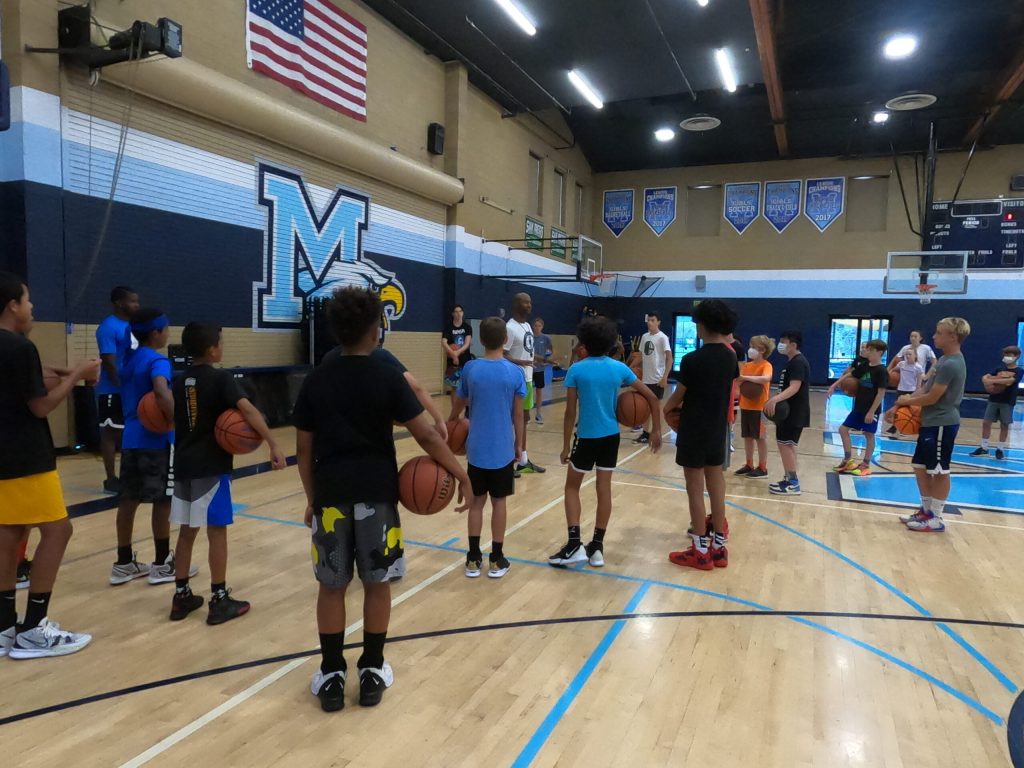
At a mega-camp with 200+ kids, your player might touch the ball 15 times in an hour. In a structured small-group session built around reps done right, that same player might get 80+ quality, coached repetitions — each one with immediate feedback on footwork, hand placement, or finishing technique.
That’s not a small gap. That’s the difference between standing in line and actually growing their game.
The 3-Question Framework: Spot a “Babysitting” Camp Instantly
Before you register for any basketball program — anywhere in San Diego — ask these three questions. The answers will tell you everything.
1. What is the player-to-coach ratio?
Anything above 10:1 means your player is largely on their own. A true development program keeps groups small enough that a coach can observe, correct, and push every single player in the session.
2. Is there a structured, written curriculum?
A real skills academy can hand you a breakdown of what your player will work on — footwork, ball-handling, passing & catching, shooting, finishing, reading & reacting — and how those skills build week over week. If the answer is “it depends on the day,” that’s a red flag.
3. How is individual progress tracked?
Development isn’t just about showing up. It’s about measurable growth. Ask if the program tracks individual skill benchmarks or provides any form of player evaluation. If there’s no accountability system, there’s no real development plan.
If a program can’t answer all three clearly, you’re paying for supervision — not coaching.
What a Structured Skills Academy Actually Looks Like
At Lamont Smith Basketball Academy, every session is built around one core principle: attention to detail and structure.
That means customized workouts tailored to each player’s individual needs and skill level. It means small group sizes specifically designed to elevate growth and development. And it means a coach who has spent 20 years at the Division I level — developing 6 NBA players along the way — who is actually on the floor running every drill.
“It’s as if my 11 and 12-year-olds are getting high-level college coaching every session with Lamont,” one San Diego parent put it.
That’s not marketing language. That’s what The Lamont Smith Experience is built to deliver, every single time.
Mega-Camp vs. Skills Academy: Side-by-Side
| Mega-Camp | Skills Academy (LSBA) | |
| Group Size | 50–300+ players | Small groups, individualized |
| Player-to-Coach Ratio | 20:1 or higher | Low ratio, direct coaching |
| Curriculum | General, day-to-day | Structured, skill-specific |
| Reps Per Session | Low (lots of waiting) | High — reps done right |
| Individual Feedback | Minimal | Real-time, drill-by-drill |
| Progress Tracking | None | Benchmarked development |
| Coaching Credentials | Varies widely | 20 Years DI Experience |
| Character Development | Incidental | Intentional — bigger than basketball |
It’s Not Just About Basketball Skills
Here’s something the comparison tables don’t always capture: the best development programs teach more than footwork.
At LSBA, we believe basketball is bigger than basketball. Every session is an opportunity to build accountability, discipline, work ethic, and communication — the same qualities that translate into the classroom, into relationships, and into life.
That’s not a tagline. It’s the reason families from La Jolla to Orange County keep coming back year after year, and why our consistent year-round basketball clinics are built around long-term player relationships, not one-week transactions.
The Bottom Line for San Diego Parents
If your goal is to keep your player busy for a week, a large camp will do the job.
But if your goal is to watch your player make a measurable leap — to see them come home with new techniques, sharper footwork, and real confidence — then you need a program built around structure, small groups, and focused college-level coaching.
The difference isn’t subtle. It shows up in the first week.
Ready to See the Difference?
We work with players at every level — beginner, intermediate, and elite — across San Diego and Orange County. Whether your player is preparing for high school tryouts, working toward college recruitment, or simply ready to stop standing in line and start developing high basketball IQ, we’re here to help them grow.
Schedule your first session today and experience what 20 years of Division I coaching looks like up close.
Frequently Asked Questions
Are big basketball camps worth the money?
It depends entirely on your goal. If you’re looking for structured skill development and individual coaching attention, most large-scale camps fall short. With player-to-coach ratios of 20:1 or higher, players spend more time waiting than working. For measurable improvement, a small-group skills academy with a structured curriculum and qualified coaching staff will consistently deliver better results.
What is the difference between a basketball camp and a basketball academy?
A basketball camp is typically a high-volume, short-term program focused on general play and recreation. A basketball academy — like Lamont Smith Basketball Academy — is a structured, curriculum-driven program where players receive individualized coaching, repetitious fundamental skill work, and measurable progress tracking. The coaching credentials, group sizes, and session structure are fundamentally different.
How many kids should be in a basketball training group?
For real development, smaller is always better. A ratio of 6:1 or lower allows a coach to observe every player, correct mechanics in real time, and tailor the session to individual needs. At LSBA, small group sizes are a non-negotiable part of how we elevate growth and development — it’s one of the core reasons players improve faster here than in large-scale programs.
 Is Your Child Ready to Move from Rec Ball to Club Basketball? Here’s the Exact Timeline